

For patients with nerve pain, pregabalin is typically prescribed after they have tried various ordinary painkillers with no success. Pregabalin is not an opioid, and it is not a painkiller in the way that paracetamol or codeine are painkillers. It is of a group of medications known as gabapentinoids, and it acts upon the nervous system rather than acting upon the site of the pain that the patient feels.
That difference in how it works explains most of what follows on this page, including why it helps when other treatments have not, and why it has to be stopped slowly.
Pregabalin is not an opioid
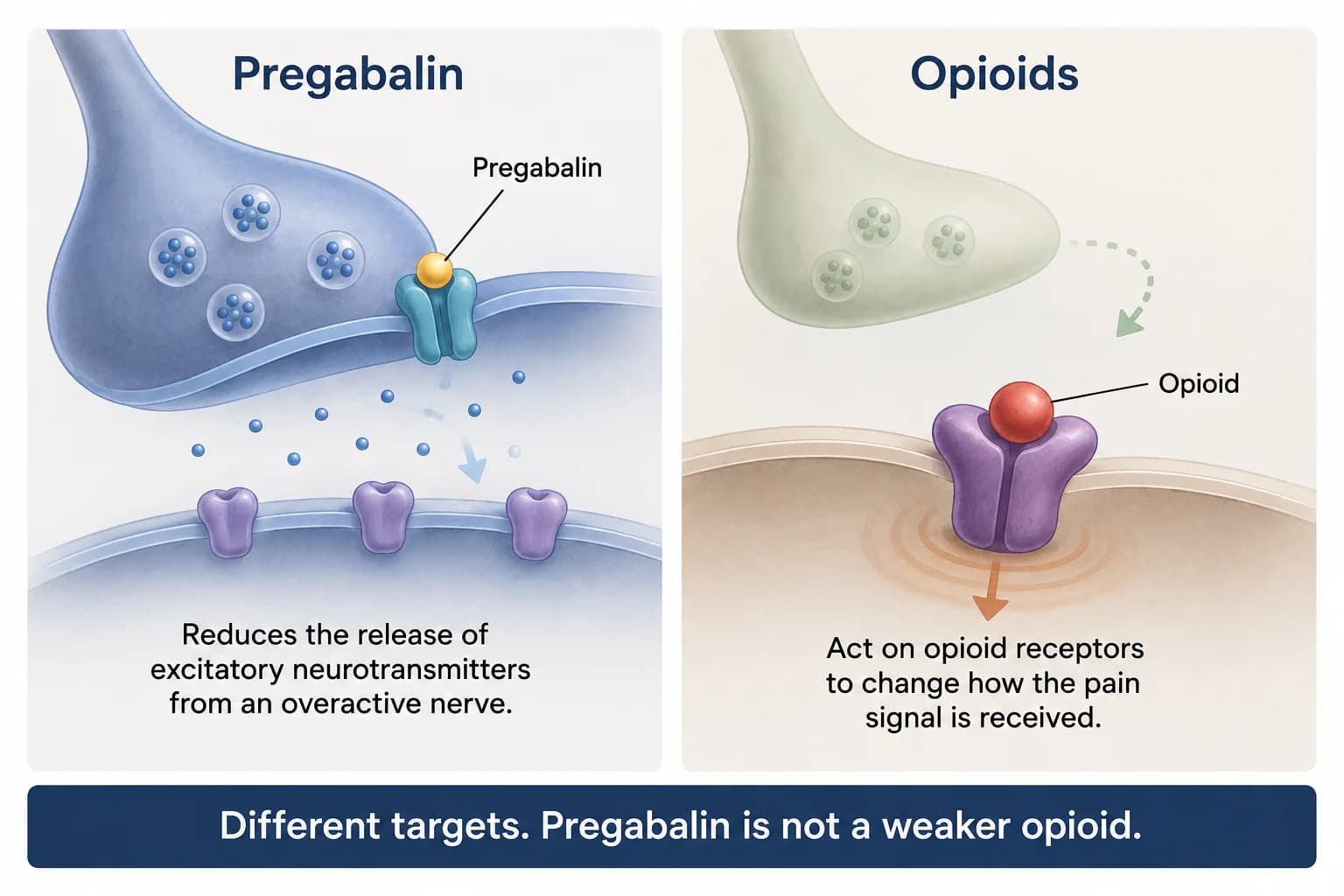
This is worth saying outright, given that pregabalin is often prescribed alongside opioids and people assume it must be one.
Pregabalin binds to a subunit of voltage-gated calcium channels that are present in nerve cells. By doing so, pregabalin reduces the release of the excitatory neurotransmitters that pass signals along nerves. It essentially turns down the volume of the signals that are passed along by overactive nerves.
Opioids work in a completely different way. They act on opioid receptors in the brain and spinal cord to alter the way that pain signals are received. Pregabalin is not a weaker opioid or a stronger paracetamol. It is a completely different type of medication altogether.
Why nerve pain does not respond to ordinary painkillers
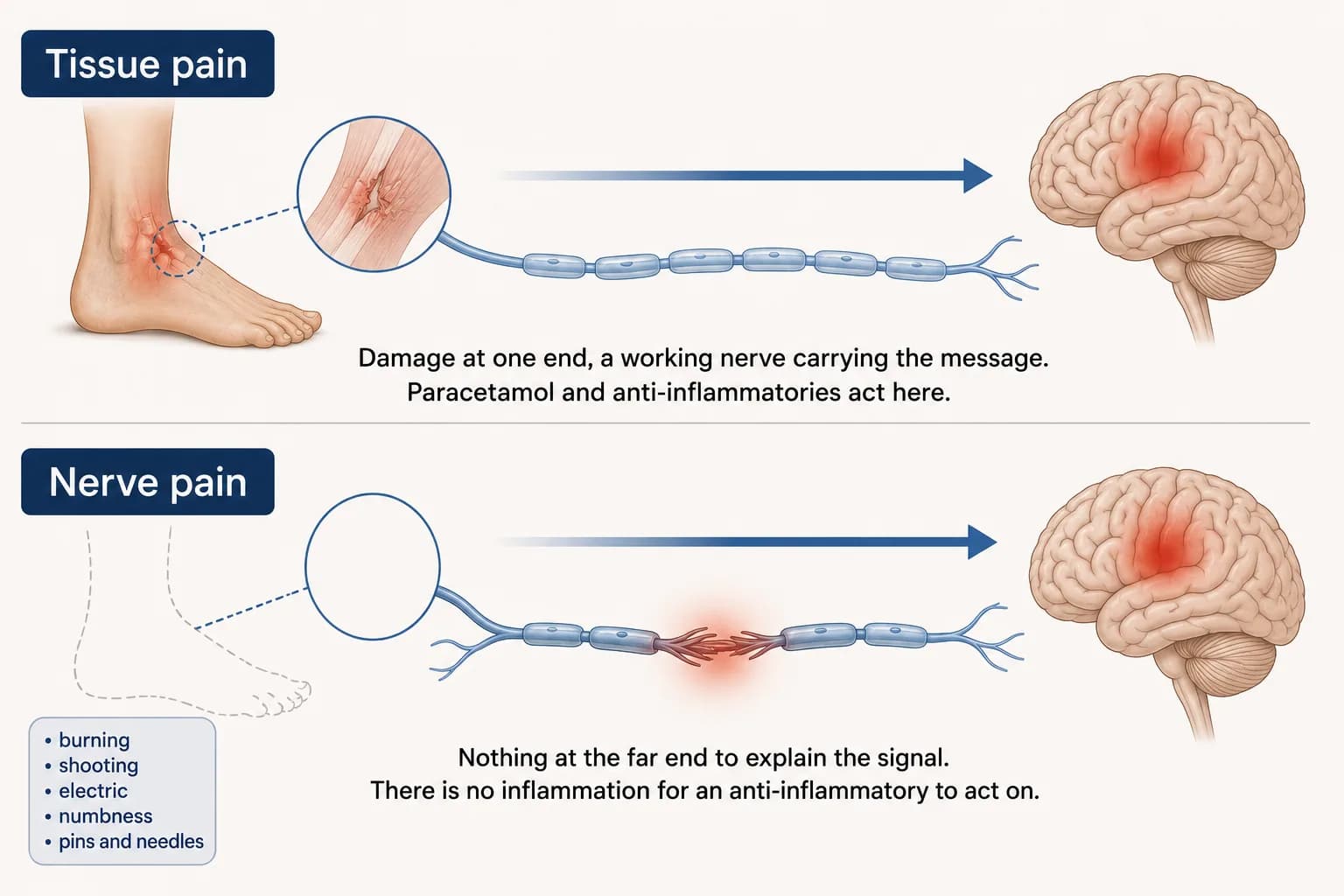
Most pain is the result of tissue being damaged. When someone sprains an ankle, the healthy nerve detects the damage and sends a signal to the brain that something is wrong with the body part. Paracetamol and anti-inflammatory medicines respond to this type of pain.
Nerve pain is different. The nerve itself is the problem. It has been damaged or is behaving abnormally, and it sends pain signals with nothing at the far end of them to explain why. The pain is often described as burning, shooting or electric, and patients often report numbness or pins and needles in the same area. Anti-inflammatory medicines do not help, because there is no inflammation for them to act on.
Nerve pain can be the result of diabetes, shingles, injuries to the spine, multiple sclerosis and some cancer treatments. Pregabalin is one of the medicines that can be used when the cause of the nerve pain cannot be removed.
What pregabalin is prescribed for
Pregabalin has three licensed uses in the European Union, all of which are for adults.
The first of these is for the treatment of peripheral and central neuropathic pain. This covers pain that arises in the nerves of the body as well as nerve pain that arises in the brain or spinal cord. The second is for the treatment of epilepsy, where pregabalin is used as an add-on treatment for adults who suffer with partial seizures, with or without secondary generalisation. This is additional to the treatments that they are currently receiving for their epilepsy. The third indication is for the use of pregabalin in adults who suffer with generalised anxiety disorder.
Pregabalin has not been proven to be safe or effective in children under the age of twelve, or in adolescents between the ages of twelve and seventeen, and so no dose can be recommended for those age groups.
How pregabalin is taken

Pregabalin comes as capsules and an oral solution of 20 mg per mL. The oral solution is useful for those who cannot swallow the capsules. Both forms are taken by mouth and can be taken with or without food.
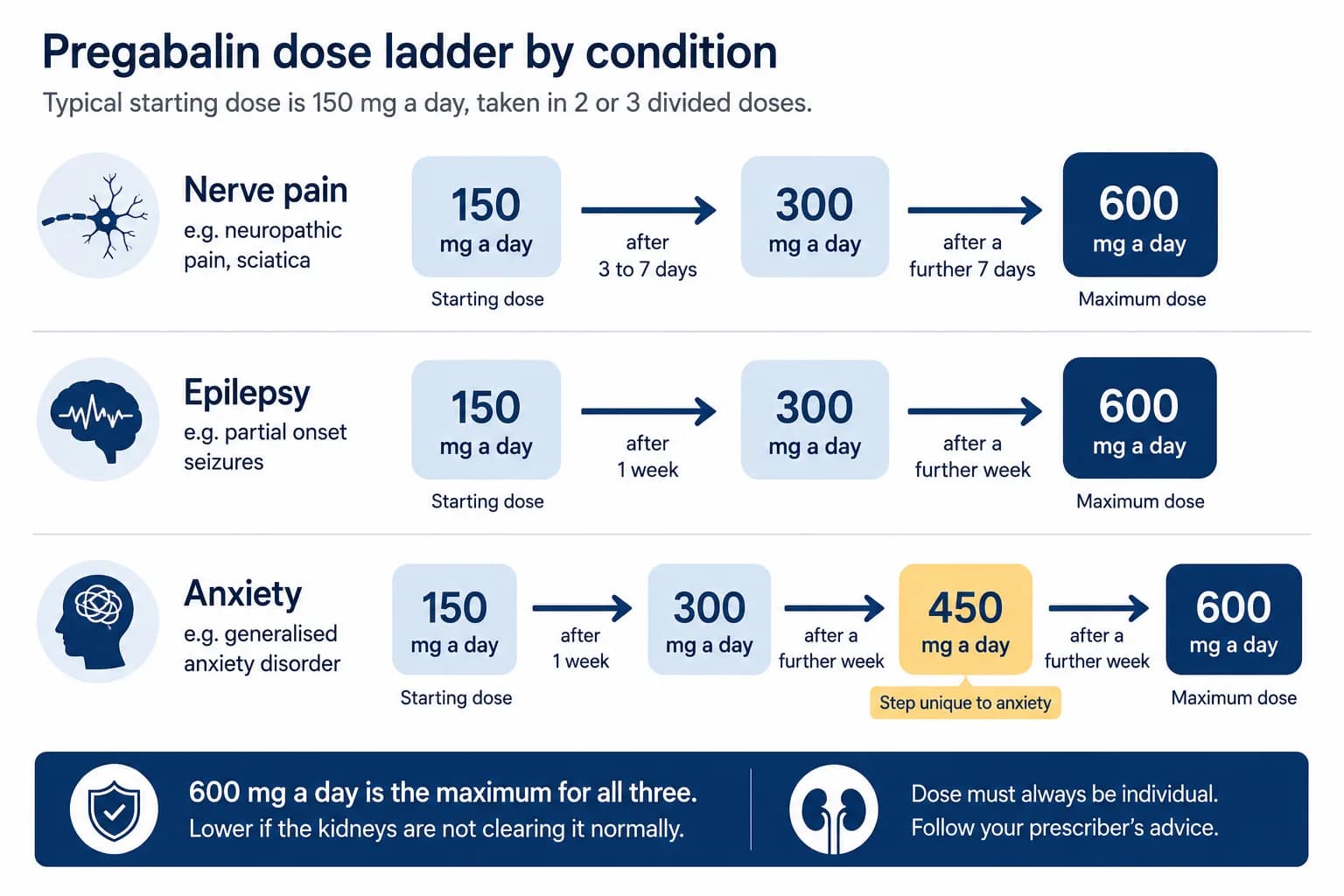
The starting dose is usually 150 mg per day, split into two or three doses spread through the day. The dose can be increased in steps if it is needed, with a gap of at least several days to a week between one step and the next, based on how well it is working and how well it is being tolerated. The steps are not the same for every condition. Anxiety has an extra intermediate step that pain and epilepsy do not use.
Because pregabalin works through the level of the drug in the bloodstream, it is important to take the doses at the same times every day.
Kidney function changes the dose
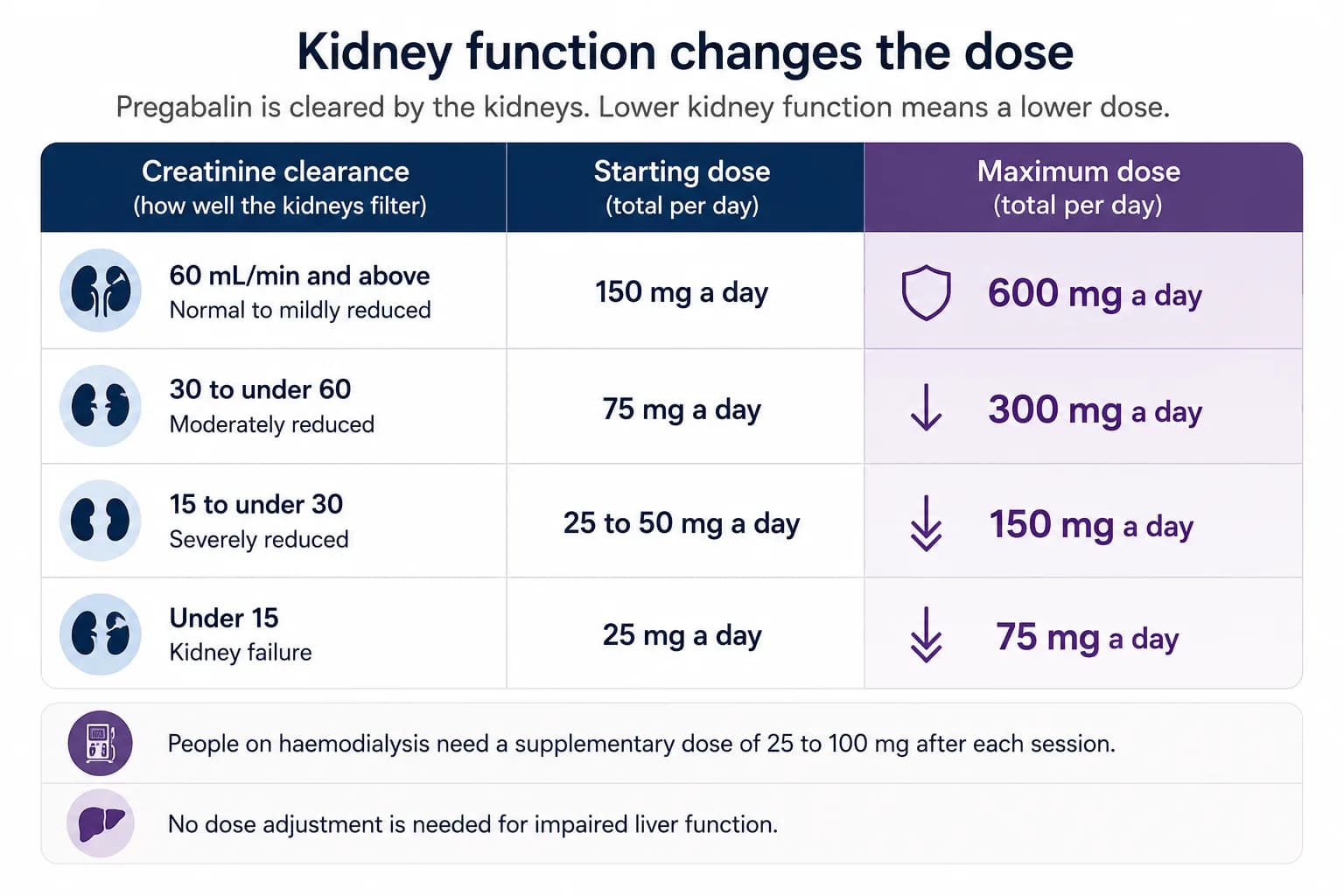
Pregabalin is eliminated through the kidneys, and it leaves the body almost entirely unchanged. It is not metabolised by the liver beforehand. This fact alone dictates the dose for pregabalin above anything else on this page.
Should kidney function decline, the dose will need to be reduced to stop the drug building up in the system. The reductions in the European product information for kidney impairment are substantial rather than token. For those with moderately impaired kidney function, the starting dose is half the usual one and the ceiling is half as high. For those with more severe impairment, the starting dose is lower again and the ceiling is a quarter as high. For those who undergo haemodialysis, an additional dose is required after each session, because dialysis removes a meaningful amount of the drug.
Pregabalin does not need to be dose adjusted for impaired liver function. This is unusual, and it follows from the drug not being broken down there in the first place. Given that kidney function tends to decline with age, older patients will usually require lower doses.
Taking pregabalin with an opioid

This is the most important warning on the page, and one that matters here more than on most sites. Pregabalin and opioids are often prescribed to the same individual for the same type of pain.
The combination of these two medications can cause severe sedation and slowed breathing. Respiratory failure, coma and deaths have been reported. The European product information makes clear who is most at risk: individuals with reduced lung function, those with respiratory or neurological disease, those with impaired kidney function, anyone taking other medications that depress the central nervous system, and the elderly. The doses of both medications may need to be adjusted for these individuals.
You will find pages online describing this as a black box warning. That is not accurate. Pregabalin carries no boxed warning in the United States, and the respiratory risk sits in the ordinary warnings section of the label there, as it does in section 4.4 of the European product information. The American regulator issued a safety communication in December 2019 and required the warnings about this combination to be strengthened. The risk is real, and the description of it should still be accurate.
The practical point stands whatever the label calls it. Anyone taking pregabalin in combination with tramadol, oxycodone, codeine, fentanyl or buprenorphine should have been told about this interaction by their prescriber, and should tell any new doctor or pharmacist about both medicines.
Mood changes and suicidal thoughts

Suicidal thoughts and behaviour have been reported in individuals who take anti-epileptic medicines for a range of conditions. A combined analysis of randomised clinical trials of medicines in this class found a small increased risk, though the reason for it is not understood. A separate study, which compared the periods in which individuals were taking pregabalin against the periods when they were off it, found evidence of an increased risk of new suicidal behaviour in individuals taking pregabalin.
Should someone experience a change in their mood, or thoughts of harming themselves, they should speak to their doctor rather than stopping the drug on their own. If someone is in immediate danger, the emergency number across the European Union is 112.
Side effects

The common side effects of pregabalin are dizziness, drowsiness, weight gain, swelling of the hands and feet, dry mouth and blurred vision.
Dizziness and drowsiness are the two that most often lead to people giving up on pregabalin. Both are at their worst during the first days of taking it and after each increase in the prescribed dose. For most people they settle after a week or two at a steady dose. This is one of the reasons for building the dose up slowly rather than starting where it needs to end.
Weight gain can develop over a longer period and is something to bring to the attention of the prescriber rather than tolerating quietly, particularly if the nerve pain is related to diabetes.
Never stop pregabalin abruptly
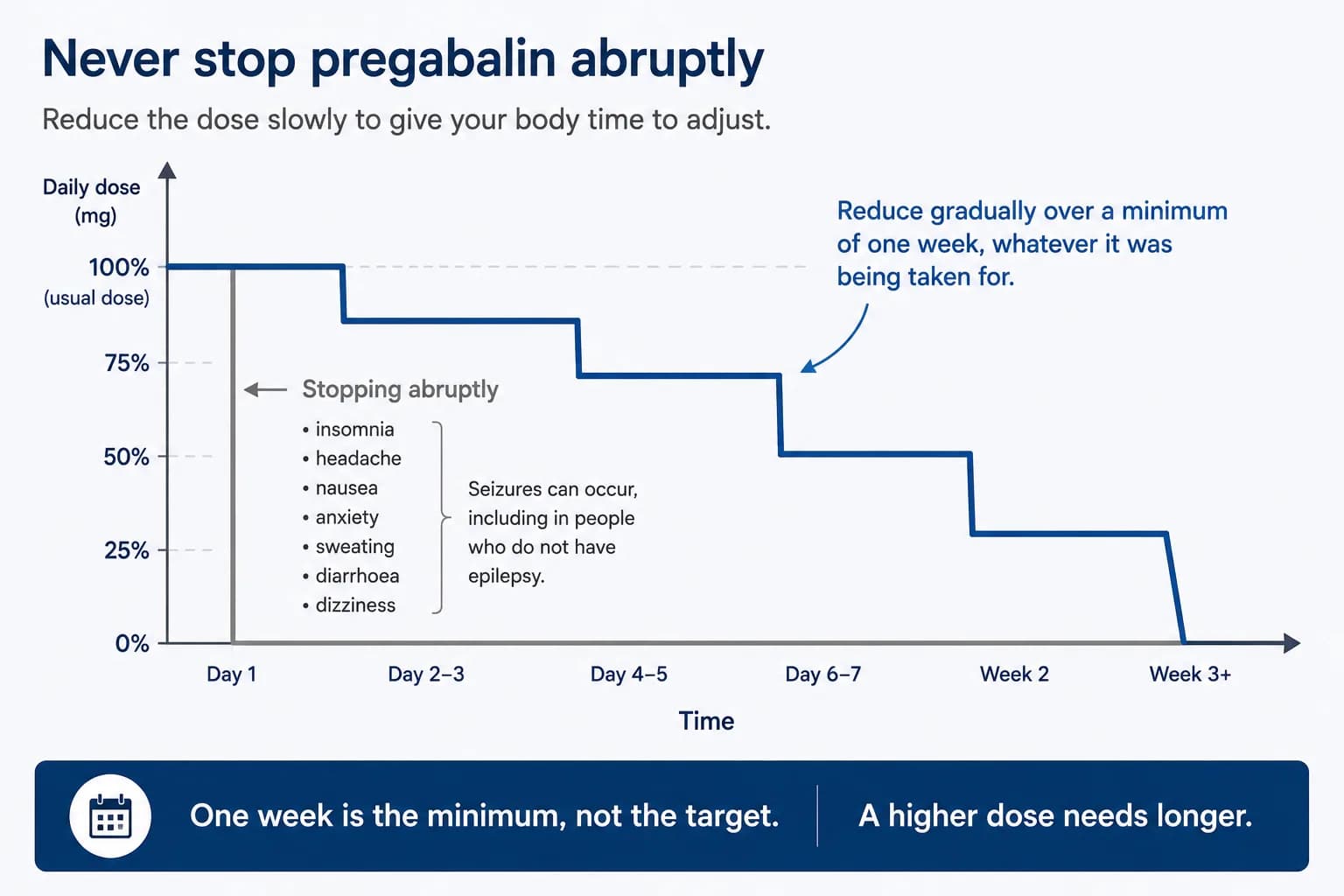
Insomnia, headache, nausea, anxiety, sweating, diarrhoea and dizziness can follow abrupt stopping of pregabalin. Seizures can occur while taking the drug or shortly after stopping it, including prolonged seizures, and this applies to people who do not have epilepsy.
The European authorisation is specific about how to stop taking it. If pregabalin is to be stopped, it should be reduced gradually over a minimum period of one week, whatever it was being taken for. Most consumer pages advise against stopping suddenly and leave it at that, without giving the instruction that follows in the product information. The higher the dose being taken, the longer the taper is likely to need, so one week is a minimum rather than a target.
The decision and the schedule belong to the prescriber. There is no reason for anyone to suffer through withdrawal by guessing at it.
Dependence and misuse
Pregabalin can be misused, and this is well documented rather than theoretical. Misuse is concentrated among people who also use opioids, both for the effect of the pregabalin itself and as a way of managing opioid withdrawal.
Dependence can also develop in people who take the medication exactly as prescribed. The European product information notes that symptoms which develop after stopping pregabalin may be an indication of dependence, and says patients should be made aware of this before they begin taking it rather than discovering it later. It is a reasonable thing to raise with a prescriber on the day it is first prescribed.
Frequently asked questions
Is pregabalin the same as Lyrica?
Yes. Lyrica is the original brand name for the drug pregabalin. Lyrica is manufactured by Pfizer and was the first brand of this drug on the market. Since the patent expired there are numerous other manufacturers of the same drug, sold under the generic name. The generic capsules and the brand name capsules contain the same amount of the same active ingredient, though they may be a different colour or carry different markings, as chosen by the manufacturer of those capsules.
What is the highest dose of Lyrica?
The maximum dose is 600 mg per day, which can be divided into two or three doses, whether it is being taken for pain, epilepsy or anxiety. A 300 mg capsule is therefore half of the maximum daily dose. For treating anxiety there is an intermediate step of 450 mg per day between 300 mg and 600 mg, which is not used for pain or epilepsy. Doses above 600 mg are not used, and the maximum is lower for anyone whose kidneys are not clearing the drug normally.
What should not be taken with pregabalin?
Alcohol is the one people underestimate. It will worsen the drowsiness and unsteadiness that some people experience with pregabalin. The same is true of benzodiazepines and sleeping tablets. Anything else with a sedating effect, including some antihistamines bought without a prescription, is worth mentioning to a pharmacist before taking it alongside pregabalin. Pregabalin does have one advantage in that it is cleared from the body by the kidneys rather than passing through the liver, so it does not carry the same long list of drug interactions as medicines like tramadol.
How long does pregabalin take to work?
The time it takes differs from one person to the next. Some people notice a difference after the first week, and improvement generally builds over the first two weeks or so, with the full benefit taking longer. In clinical trials of patients with nerve pain, those taking pregabalin experienced an average reduction of around one point on an eleven point pain scale by the first day, two points by around day thirteen and three points by around day twenty three. Those figures are averages across groups of patients rather than a promise to any one person. The dose is also being increased over that same period, so judging the drug after a few days is judging it too early.
Can you drive while taking pregabalin?
Not until you know how it affects you. Pregabalin slows reaction times as well as causing the drowsiness described above, and a person who feels alert enough to drive is not always a reliable judge of that. The safe approach is to wait until you have been on a steady dose long enough to know what it does to you, and to treat every dose increase as starting that clock again. Driving laws covering medicines differ between European countries, and in several of them driving while impaired by a prescribed medicine is an offence in the same way that drink driving is.
Is pregabalin a controlled drug?
It depends on the country in which you are taking it, and there is no single European position. In the UK, pregabalin has been a Class C controlled drug since April 2019, which means a prescription must be signed by the doctor and dispensed within twenty eight days. In the United States it is a Schedule V controlled substance. Norway, Sweden and Finland introduced restrictions on the prescribing and dispensing of pregabalin from 2015 onwards, and France has a secured prescription requirement. Other European countries treat it as an ordinary prescription medicine. Check the rule where you live rather than assuming that the one you have read about applies.
Can pregabalin be used for anxiety?
Yes, and it is a licensed use rather than an off label one, which is not true of every medicine given for anxiety. It is not usually the first thing prescribed, since talking therapies and antidepressants generally come first. Unlike a benzodiazepine, pregabalin is not a short term calming medicine taken when anxiety spikes. It is taken continuously and takes several weeks to build its full effect. It does not build tolerance at the speed that benzodiazepines do, though it carries dependence risks of its own, as described above.
What happens if you miss a dose?
Take it as soon as you remember, unless it is nearly time for the next one. In that case skip the dose you missed and take the next one at its normal time. Never take a double dose to make up for a forgotten one. For those taking pregabalin for epilepsy, a missed dose matters more, because a gap in treatment can bring on a seizure. Anyone who misses doses regularly should say so at their next appointment, since the schedule can usually be made easier to keep to.
About this information
The dosing figures, warnings and licensed uses on this page come from the European product information for pregabalin. The regulatory points are attributed in the text, so you can see which country each one applies to. Where a widely repeated claim is inaccurate, as with the black box warning that pregabalin does not actually carry, this page says so rather than repeating it.
Reviewed by Euro Pharma Care Team